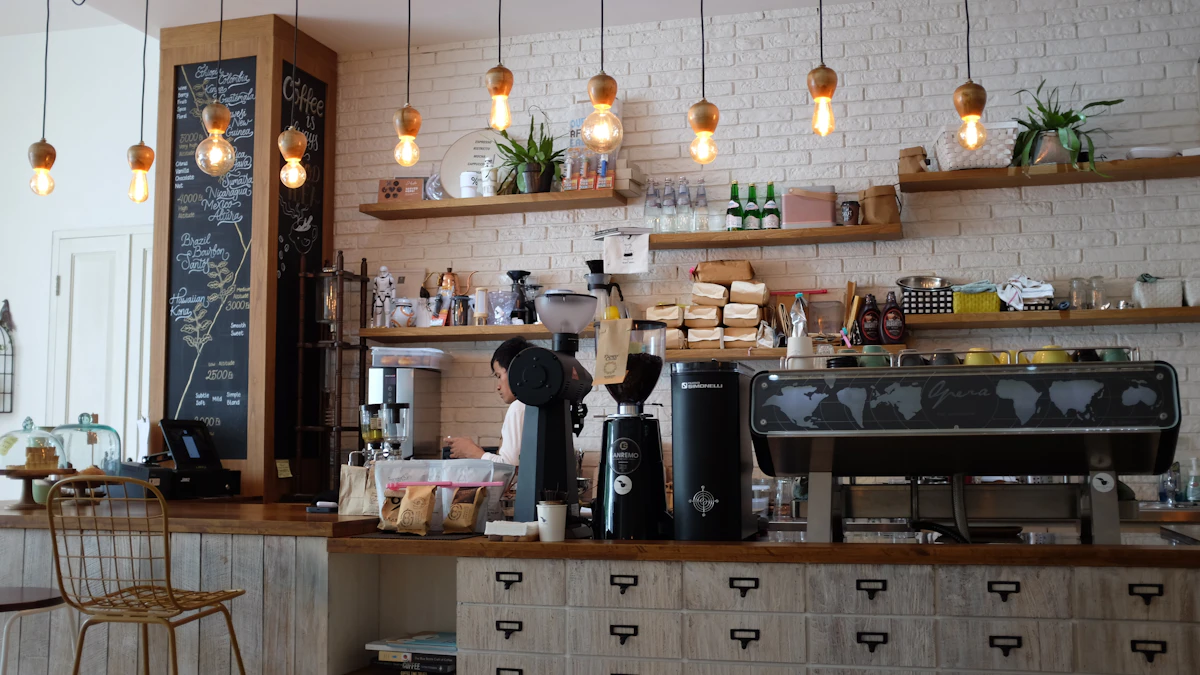
Minimalist third-wave UK speciality coffee bar with timber counter, open layout and steam rising from the espresso machine

UK Sector Specialism · Class E (Daytime)

The UK's Specialist Broker for Specialty Coffee Shop Businesses

Connecting independent operators with vetted private and trade acquirers. Fully off-market. Fully protected.

Operational realities

What actually drives value in the specialty coffee shop sector

Specialty coffee operators live and die by a sharply skewed wet-to-dry sales mix — typically 80% beverage, 20% pastry. Valuations are driven less by square-footage and more by brand equity, barista retention, morning commuter footfall, and whether the espresso plant is owned outright or saddled with a finance lease.

Benchmark valuation framework

Adjusted Net Profit + Asset Value · 1.8× – 2.5× applied to adjusted net profit (SDE).

Wet-to-dry sales ratio

~80 / 20

Espresso, filter and milk drinks dominate revenue. Pastry and food top-ups protect the average ticket but rarely drive valuation.

Target beverage gross margin

70 – 75%

Achievable on espresso and filter — but only if menu pricing flexes with green-bean inflation and the oat-vs-dairy split is actively managed.

Equipment status premium

Owned vs leased

Unencumbered La Marzocco, Victoria Arduino or Mythos grinders lift the asking price. Active finance leases compress the upfront cash offer.

Footfall driver

Mon–Fri AM commuter

Buyers underwrite the 7:30–10:30 window. A documented loyalty / regulars base is what defends the multiple in a downturn.

Take the next step — privately

Two paths into the specialty coffee shop market

Whether you're planning a confidential exit or building a considered acquisition brief, every conversation is NDA-gated and never appears on a public listings portal.

For owners looking to exit

Test the value of your business before you commit to a sale

Sector-specialist valuation and a private advisor conversation — with zero exposure of your business to the open market.

Secure Your Confidential Sector Valuation →

For registered & aspiring buyers

See the specialty coffee shop opportunities the open market never does

Register an acquisition brief or join the regional alert list and we'll match you against off-market businesses before they become publicly known.

Register Your Acquisition Brief →

Sector deep-dive · operator-grade analysis

Specialty Coffee Shop: the operational, economic and lease realities

Long-form analysis written for owner-operators considering a confidential exit and for serious acquirers building a defensible brief. No surface-level overviews; no SEO filler.

Operational profile

Day-to-day workflow in a specialty coffee shop site

A UK specialty coffee shop is a single-trade espresso operation engineered around a tightly compressed morning peak. The classic third-wave site opens between 06:30 and 07:30 and trades into a sustained 08:00–10:30 window during which 55–65% of weekday revenue is taken. The remaining hours act as a long, slowly tapering shoulder: a mid-morning meeting pulse, a thin lunch crossover, and a 14:00–16:30 stretch dominated by remote workers, repeat regulars and the occasional flat-white-as-dessert pickup.

Transaction volume, not table dwell time, is the operational engine. A well-laid bar with a two-group La Marzocco Linea PB and a Mythos One grinder will sustain 110–140 covers an hour during peak with two trained baristas plus a runner, provided the order-take and the milk-steaming choreography are properly separated. Sites with a single bar staff member and a queueing till capping at roughly 75 drinks per hour will lose 18–25% of theoretical morning revenue to walk-aways during the 08:30 commuter compression.

Seating is structurally secondary. Most specialty shops operate a 60:40 to 80:20 takeaway:dine-in split by transaction count, and many sites trade comfortably with 8–18 covers. Where dine-in covers exist, average dwell sits between 22 and 38 minutes for solo customers and stretches to an hour for meetings; both push secondary spend (a second filter, a pastry) but rarely justify giving up bar-adjacent retail space to add tables. The most defensible operators design the floor so the queue dissolves into the seated area, never the door.

Customer acquisition is geographic, not digital. The catchment is functionally a 6–9 minute walking radius from a residential, commuter or office anchor; outside that envelope, conversion drops sharply regardless of social media reach. The dominant repeat behaviours are a five-day commuter habit (weekday flat white plus pastry), a weekend leisure visit (filter, brew bar, pastry, sometimes a second round), and an emerging remote-work pattern in suburban high-street sites that lifts the 10:00–13:00 trough by 12–20%.

Operationally, three workflows govern everything else: dialling-in espresso twice daily as green-bean batches rotate, calibrating milk steaming to the day’s oat-versus-dairy mix, and managing pastry intake from a partner wholesale baker without holding sellable inventory overnight. A site that runs these three workflows cleanly, with a head barista who owns dial-in and a documented opening checklist, will trade through a 30% senior-staff turnover year without visible service degradation. A site that hasn’t will not.

Micro-economics

Margins, wage thresholds and waste discipline

Specialty coffee economics are dominated by a sharply skewed wet-to-dry mix. The benchmark UK independent runs 78–82% of revenue through beverage and 18–22% through pastry, retail bags and food. Beverage gross margin sits at 70–78% after milk, beans, syrup and cup; pastry gross margin lands at 55–65% when bought wholesale from a partner baker, and slips below 50% in any week the wastage rate breaks 12%. The blended COGS line for a well-run site is 24–28% of net turnover.

Wages are the single most consequential cost. Across UK specialty independents the operating benchmark is a wage:turnover ratio of 28–34%, including the working owner’s notional salary and employer NICs at 13.8%. Anything sustained above 36% is a structural problem — usually a peak-hour rota that is over-staffed for the off-peak hours rather than a head-rate issue. The 2024–2025 National Living Wage uplift to £12.21/hr at 21+ has pushed an additional 2–4 percentage points onto wage ratios for sites that did not raise drink prices in step.

Milk strategy materially distorts margin. A 12oz flat white made on 3.7% fat dairy at £1.05/litre costs roughly 11p in milk; the same drink on a premium barista-grade oat at £1.85/litre costs 19p. At a typical £3.80 sell price, this single switch shaves 2.1 percentage points off beverage gross margin. The widening of the oat split — commonly 35–50% of milk volume in metropolitan sites — is now a primary driver of margin erosion, and it cannot be priced away easily because regulars resist a non-dairy surcharge above 50p.

Waste mitigation in specialty coffee is mostly about retail and pastry, not beans. Bean wastage is usually 2–4% (purge during dial-in, demo drinks, rejected shots) and is essentially fixed. Pastry wastage is where margin leaks: an undisciplined site routinely discards 14–18% of intake. The fix is operational, not procurement: a documented end-of-day mark-down cascade from 14:30 (15% off) to 16:00 (40% off), a sealed sale-or-return clause with the wholesale baker, and a Friday-only reduced intake calibrated against an eight-week rolling average.

Below-line, the recurring costs that surprise buyers are equipment service contracts (£1,200–£2,400 per year for the espresso machine and grinder), water filtration cartridge changes every 6–9 months at £180–£320, card fees at 1.4–1.7% of revenue when stacked across Stripe/Square and contactless, and the music licence (PPL/PRS) that catches roughly one in three independents during VAT-quarter audits.

Leasehold integrity

Class E, FRI obligations and plant assets

Almost every UK specialty coffee shop trades under a Class E commercial lease (the post-2020 use class that merged the old A1/A3/B1 boundaries). Class E is, in itself, a value lever: a buyer can pivot the unit between retail, restaurant and office-style use without planning friction, which broadens the resale pool meaningfully. The lease itself, however, is where deals routinely die. The two failure modes are an absent or restrictive alienation clause and an under-disclosed full repairing and insuring (FRI) liability on plant.

The alienation clause governs whether the lease can be assigned to a buyer. In a clean specialty coffee deal the lease permits assignment with landlord consent “not to be unreasonably withheld,” subject to financial references and usually an authorised guarantee agreement (AGA) from the outgoing tenant for the duration of the original term. Where the lease requires the landlord to be offered surrender first, or to take a personal-guarantee uplift, the assignment timeline stretches from a typical 6–10 weeks to 14–20 weeks, and that delay alone collapses one deal in five.

FRI liability is the second hidden risk. A repairing covenant phrased as “keep the premises in good and substantial repair” transfers responsibility for the shopfront, the air-conditioning condenser on the rear elevation, the extraction ducting and any soil-stack remediation to the tenant — even where those items were already at end-of-life on day one. A schedule of condition appended to the lease is the only effective protection. Buyers should price the absence of one as a discount of 6–10% on goodwill.

Specialty coffee unique plant is light by hospitality standards but high-value: a three-year-old two-group La Marzocco carries a depreciated value of £7,800–£9,400; a Mythos One grinder £2,100–£2,600; a refrigerated under-counter milk fridge £900–£1,400; a brew bar with kalita and v60 stations £600–£1,200. Where any of this plant is on a finance lease (commonly a 36 or 48-month BNP Paribas, Shawbrook or PMS facility), the asset is not the operator’s to sell. Buyers and brokers must obtain a written novation quote from the finance house before exchange — this is the single most common reason a specialty coffee deal exchanges late.

Extraction is rarely an issue in espresso-only sites because there is no gas cooking line and no Class 1 hood. Where the operator has installed a panini grill, a small toaster oven or a counter-top kitchen, the obligations under the landlord’s buildings insurance and the local environmental health regime tighten meaningfully — expect to evidence annual TR19 ducting cleans and a current PAT testing certificate at completion.

Growth vectors

Pragmatic scaling for owner-operators

Specialty coffee growth tends to follow one of four trajectories, and the credible buyer can usually see which trajectory a specific site supports within the first walk-through. The four vectors are wholesale supply, retail bag distribution, a documented second-site playbook, and event/training revenue.

Wholesale supply is the cleanest scaling lever. An operator with established roast-partner relationships can layer 8–14 weekly accounts (local restaurants, hotel breakfast services, office buildings, gyms) onto an existing operation without a meaningful capex line. The economics are different from front-of-house: wholesale beans sell at £22–£28/kg ex-VAT against a roaster trade price of £15–£18/kg, so the gross margin per kg is lower than retail espresso but the volume compounds quickly. A mature wholesale book at 90–140kg/week is a discrete asset worth 8–14× monthly contribution at sale.

Retail bag distribution — 250g retail bags through the front counter and an opt-in subscription channel — is undervalued. A site that shifts 35–60 retail bags per week at £11–£14 each generates £20,000–£40,000 of high-margin annual revenue with almost no incremental labour. Where the operator has built a subscription tail of 80–200 named customers through a Shopify or Cornershop layer, that subscription book is a separately monetisable asset at exit.

A second-site playbook is what separates a lifestyle owner-operator business from one that institutional acquirers will pay a premium for. The playbook is operational documentation: a written training programme, a 14-day opening schedule, an espresso dial-in protocol, a supplier list with negotiated rates and a P&L template that maps to the existing site within a +/- 2% variance. Sites with that documentation regularly transact at a half-multiple premium to comparable revenue.

Event and training revenue completes the picture. A Saturday morning home-barista class (£65–£95 per head, eight seats, four hours of trained barista time) generates £520–£760 of nearly all-margin revenue without disturbing the front-of-house trade. Out-of-hours private hire, supplier cuppings, and corporate barista training days for nearby offices each unlock secondary revenue lines that do not cannibalise the morning peak. Delivery aggregators (Deliveroo, Uber Eats) typically contribute 3–7% of revenue at 28–33% commission — a useful incremental layer but rarely a strategic axis.

The composite outcome of running two or more of these vectors well is a sale-side narrative that prices the business off forward-looking contribution rather than backward-looking EBITDA — commonly worth a 0.3–0.6 multiple uplift at exchange.

Sector FAQs · expert-level answers

Specialty Coffee Shop brokerage: deep operator questions answered

Can I assign a La Marzocco machine on finance to a buyer of my specialty coffee shop?+

Not automatically. A La Marzocco (or similar) on a 36 or 48-month finance lease is owned by the finance house — typically Shawbrook, BNP Paribas Leasing Solutions, or a manufacturer-backed scheme — until the final payment plus the option-to-purchase fee clears. To transfer it to a buyer you need a written novation quote, which the finance house will only issue once it has run a credit check on the incoming director. The realistic timeline is 10–18 working days. Where the buyer fails the credit check, the practical fix is for them to settle the finance balance on completion and roll the residual value into the goodwill price, with the cash adjustment landed in the SPV. Brokers should always request a redemption statement at heads-of-terms stage; deals that surface a finance encumbrance at exchange routinely renegotiate downward by 4–8% as the buyer absorbs the working-capital hit.

How is barista retention factored into the valuation of a specialty coffee business?+

Sophisticated acquirers price barista retention as a discrete goodwill risk, not a soft factor. A head barista who has owned dial-in, supplier relationships, and weekend rota for 18+ months represents a meaningful share of the trading goodwill — if they walk on a change of ownership, the new owner faces a 10–14-week capability gap that materially depresses morning peak revenue. The defensible structure is to disclose contractual notice periods, document the dial-in protocol in writing before marketing the business, and ideally negotiate a 90-day handover retention bonus payable by the buyer post-completion. Where a sole working owner is also the head barista, valuation typically lands at the lower end of the 1.8×–2.5× SDE band because key-person dependency cannot be priced away — unless the owner agrees to a 6–12 month consulting tail.

Why is the oat milk versus dairy split eroding my specialty coffee margins, and what's the fix?+

The structural answer is that barista-grade oat milk (Oatly Barista, Minor Figures, Plenish) costs 1.6–1.9× per litre what whole dairy does, and the typical UK specialty site has watched its oat share grow from roughly 18% in 2019 to 35–50% today. At a 45% oat split, a site moves 2.0–2.3 percentage points of beverage gross margin per year onto its supplier line without changing a single price or recipe. The three credible fixes are: (1) renegotiate the wholesale oat-milk supply through a coffee-roaster co-purchase agreement, which typically unlocks a 14–22% case price reduction; (2) introduce a 40–50p non-dairy surcharge — politically sensitive, but the regulars who object are usually a smaller cohort than baristas fear; (3) move the menu architecture so dairy alternatives are bundled into a premium pricing tier rather than displayed as a discrete add-on. The blended outcome typically recovers 1.3–1.8 percentage points without measurable churn.

How does the sensory layout of a specialty coffee shop affect its asking price?+

Buyers — and especially institutional acquirers building a portfolio — pay measurably more for sites with a sensory layout that signals competence to the trade walking past. The defensible markers are an exposed La Marzocco or similar high-status machine visible from the street; a bar height of 1,050–1,100mm that puts the brew action at chest height for the customer; a single, legible chalk or printed menu; and a queue path that runs parallel to (not perpendicular to) the bar, so the customer watches their drink being made. Sites with these features sell at the upper end of the multiplier band because the brand work has already been done — the buyer inherits a venue that looks like a destination, not a high-street coffee unit. Where the existing fit-out is a wood-clad utilitarian setup with the machine tucked sideways, expect the goodwill to settle 6–12% below comparable sites, because the buyer is implicitly pricing in a £8,000–£18,000 refit.

What multiple should I expect for an established UK specialty coffee shop with strong morning trade?+

Adjusted net profit / SDE multiples for a UK specialty coffee shop typically run 1.8×–2.5×. The variables that push toward the top of the band are: a documented wholesale book of 60kg+ per week; espresso plant owned outright (no finance leases); a head barista on a contractual notice and not the owner; a lease with at least 6 years to run on a sub-15% rent-to-turnover ratio; and a documented retail subscription tail. The variables that push toward the bottom of the band are key-person dependency on the owner, finance-encumbered plant, a sub-3-year lease tail, a rent review pending within 12 months, and an undocumented dial-in or training protocol. A well-presented site with three of the five upward markers commonly transacts at 2.3×–2.5× plus separately negotiated stock at cost; the same site with three of the five downward markers transacts at 1.6×–1.9× and routinely takes 14–22 weeks to find a buyer.

How is morning commuter footfall verified during due diligence on a specialty coffee shop?+

Serious acquirers run a three-track verification. The first track is the EPOS data: a 13-week hourly transaction extract from Square, Lightspeed, or Toast, broken out by daypart so the buyer can model the morning compression independently. The second track is a physical 5-day count, usually outsourced to a footfall agency or conducted by the buyer's representative, which captures both door-count and conversion rate during the 07:30–10:30 window. The third track is council, transport and landlord footfall data: TfL exit counts for transit-adjacent sites, the local BID's pedestrian-counter dataset where one exists, and the landlord's anchor-tenant footfall reports for parade and shopping-centre sites. Where these three datasets reconcile within +/- 8%, the buyer treats the trading numbers as verified and proceeds to exchange. Where they diverge, deals routinely break on the basis that the seller has either over-reported transaction volume or smoothed seasonality.

Pillar guides for specialty coffee shop operators

Flat-lay of a ceramic coffee cup, notepad and pen on a warm wooden desk — preparing a UK café valuation
Traditional cafe26 min read

The Master Guide to Valuing a Café or Coffee Shop in the UK

A long-form, owner-first valuation playbook covering Adjusted Net Profit (EBITDA) add-backs, the eight fixed-premises taxonomy frameworks, lease-length mechanics under the 1954 Act, realistic 2026 multiplier ranges, and the deflators that quietly cut six figures off an asking price.

Read guide →
Architectural facade of an independent UK boutique café on a quiet British high street
Bistro cafe14 min read

Navigating Class E Commercial Leases and Assignments for Cafe Owners

A working-owner's guide to Class E use, FRI lease liabilities, the Licence to Assign process, AGAs, rent reviews and the practical decisions that protect value when transferring a café leasehold.

Read guide →
Display of fresh artisan pastries inside the curved glass counter of a UK independent café
Traditional cafe12 min read

Café Rent Reviews & Lease Renewals — An Owner's Plain-English Guide

How upward-only rent reviews, the Landlord and Tenant Act 1954 renewal mechanism, surrender premiums and lease re-gears actually work — and the eighteen-month playbook independent café owners use to walk into negotiations from a position of strength.

Read guide →
Warm café lighting with steam rising from an espresso machine — the unmistakable atmosphere of a UK independent operator
Specialty coffee shop13 min read

The Broker Firewall: How to Sell Your Hospitality Business with Total Confidentiality

A working guide to confidential, off-market disposal — the real cost of public leaks, the matchmaking blueprint we use for trade and corporate buyers, when blind portal profiles still serve smaller assets, and how vetting and NDAs are layered to protect goodwill.

Read guide →
Organised behind-the-counter workspace inside an independent UK café — tools, tickets and prep stations laid out
Tea room13 min read

The Café Owner's Practical Guide to TUPE Regulations and Staff Transfers

A plain-English, working-owner's guide to TUPE — what automatically transfers with the business, the consultation timeline, the strict limits on post-sale contract changes, and the realistic handling of zero-hour contracts, refusals to transfer and pre-existing disciplinary issues.

Read guide →
Top-down latte art in a flat white — the daily cup-quality a UK café buyer is acquiring on day one
Traditional cafe14 min read

How to Buy a Café in the UK — A First-Time Buyer's Playbook

A practical, honest playbook for first-time UK café buyers covering realistic budgets, deposits, lender expectations, viewing red flags, due diligence priorities and what actually happens in the first ninety days after completion.

Read guide →
Stack of accounts paperwork beside a ceramic mug of black coffee at a UK café owner's kitchen table
Traditional cafe13 min read

The Café Buyer's Due Diligence Checklist — A 2026 UK Playbook

A practical, line-by-line due diligence checklist for UK café buyers covering the lease, accounts, EPOS data, staff, equipment, licensing, food hygiene, supplier contracts and the small details that quietly decide whether a deal becomes a good business or an expensive mistake.

Read guide →
Specialty single-origin filter coffee in a glass server beside ceramic cupping bowls on a UK café bench
Specialty coffee shop13 min read

Selling a Specialty Coffee Shop in 2026 — The Owner's Sector Playbook

A specialty-specific selling playbook covering what 2026 buyers actually pay for — brand, beans, baristas, equipment stack, wholesale and the in-house roastery — plus realistic multiplier ranges, the deflators unique to specialty, and the pre-sale moves that consistently lift the final completion figure.

Read guide →

Other UK fixed-premises sectors

Specialty Coffee Shop & Espresso Bar: Specialty coffee shop for sale UK · espresso bar business · third-wave coffee shop turnover